
What is Chronic Primary Pain?
Chronic primary pain (CPP) is a term that has been implemented in the latest revision of the International Classification of Diseases (ICD-11), which came into effect in 2022. It is defined as pain in one or more body systems (e.g. nervous, musculoskeletal, and gastrointestinal systems), and in any body site (face, low-back, neck, upper-limb, thorax, abdominal, pelvis, and urogenital region), or in a combination of body sites (e.g. widespread pain) that:
- persists or recurs for longer than 3 months;
- is associated with significant emotional distress (e.g. anger, anxiety, or depressed mood) and/or significant functional disability (impacts on one's activities of daily life, hobbies, and participation in social roles);
- and the symptoms are not better accounted for by another diagnosis.
Chronic primary pain is therefore the dominant clinical problem and is considered a condition in its own right. Before a diagnosis of chronic primary pain can be made, diagnoses that could explain this pain need to be ruled out through a proper assessment. If the pain can be accounted for by another diagnosis, it will be categorised as a form of chronic secondary pain, which includes chronic cancer pain, chronic postsurgical or posttraumatic pain, chronic neuropathic pain, chronic secondary headache or orofacial pain, chronic secondary visceral pain, and chronic secondary musculoskeletal pain.
What clinical presentations are categorised as chronic primary pain?
Many chronic pain conditions have unclear causes and pathophysiology. They are better represented by a complex interaction between biological, psychological, and social factors that vary from individual to individual. The following pains are considered chronic primary pain:
- Chronic widespread pain (CWP) such as fibromyalgia
- Complex regional pain syndrome
- Chronic headaches and orofacial pain: migraine, tension-type headache, trigeminal autonomic cephalgias, temporomandibular disorders, burning mouth, orofacial pain
- Chronic visceral pain: chest pain syndrome, epigastric pain syndrome, irritable bowel syndrome, abdominal pain syndrome, bladder pain syndrome, pelvic pain syndrome
- Chronic musculoskeletal pain (other than orofacial): cervical pain, thoracic pain, low back pain, limb pain
Chronic widespread pain
Chronic widespread pain (CWP) is musculoskeletal pain which presents diffusely in at least 4 of the 5 body regions and in at least 3 body quadrants (upper-lower-left-right of the body) and axial skeleton (neck, back, chest, and abdomen)[1]. There are several core attributes of CWP, including pain persisting for at least three months alongside signs of significant emotional distress or functional disability. This category includes fibromyalgia as a form of CWP. Diagnosis for this condition can be difficult but may be indicated if the physiological cause of pain or nociceptive activity cannot be determined, and significant nociplastic (e.g. hyperalgesic), psychological or social contributors are present. Conditions such as obesity and diabetes are often associated with CWP, highlighting an increase in comorbidities in people presenting with this condition.
Complex regional pain syndrome
Complex regional pain syndrome (CRPS) is characterised by spontaneous regional pain, often beginning distally, that is disproportionate (in magnitude or duration) to the typical course of pain after similar tissue trauma[3]. The condition is identified by various signs of autonomic and inflammatory changes that can vary among patients and change over time. Symptoms such as hyperalgesia, skin colour and temperature changes, sweating, reduced strength, tremors and dystonia may be reported in the affected limb. Two subtypes of CRPS have been outlined: type 1 and type 2. Both can occur after trauma, however, type 1 indicates there is no evidence of peripheral nerve injury, whilst type 2 requires this for diagnosis. Chronic pain after peripheral nerve injury is also considered an additional parent of the diagnosis.
Chronic primary headache or orofacial pain
Chronic primary headache or orofacial pain is defined as headaches or orofacial pains that occur for more than two hours per day on at least 50% of the days during the last 3 months[4]. Other diagnoses to be considered are listed under chronic secondary headache and orofacial pain. Diagnosis of chronic primary headache or orofacial pain is based on the current phenotype of the reported headache, with each distinct type, subtype or sub form of headache being coded and diagnosed individually. In the case of a patient receiving multiple diagnoses, prioritisation should be based on the patient's preference. Several subtypes of chronic primary headache or orofacial pain can be defined: chronic migraine, chronic tension-type headaches, trigeminal autonomic cephalalgias, chronic temporomandibular disorder and chronic burning mouth pain. To find out more about subtypes of chronic primary headache, read Nicholas et al, 2019[5].
Chronic primary visceral pain
Chronic pain localised to the head, neck, thoracic abdominal or pelvic region may be related to chronic primary visceral pain. The respective location of pain may coincide with typical referral patterns from internal organs. Examples may be from the thoracic region (e.g. non-cardiac chest pain or reflux hypersensitivity), abdominal region arising from the viscera of the digestive system (e.g. IBS, epigastric pain syndrome) and in the pelvic region via the urinary, digestive and genital systems (e.g. bladder pain syndromes, chronic pelvic pain). Subtypes of chronic primary visceral pain should be considered[2]. Chronic primary chest pain, chronic epigastric pain syndrome, irritable bowel syndrome (IBS) and chronic primary abdominal, bladder and pelvic pain syndromes are included in the subtypes of primary visceral pain and can be explored further here.
Chronic primary musculoskeletal pain (other than orofacial)
Chronic primary musculoskeletal pain is located in muscles, bones and tendons. Some of the most common examples of this include cervical, thoracic, lumbar and limb pains. These syndromes are distinguished by location: chronic primary cervical/thoracic/low-back/limb pain respectively. Reported symptoms may include localised pain and allodynia and/or hyperalgesia presenting either spontaneously or upon being evoked[2].
How to diagnose chronic primary pain
As mentioned previously, to diagnose chronic primary pain, ruling out other causes of the reported symptoms is required. Identification of factors which are contributing to the individual's pain experience is required. This can be achieved by conducting a multifactorial, person-centred assessment exploring potential causes related to aspects of biological, psychological, and sociological constructs. This includes, but is not limited to, an assessment of the patient's clinical presentation using a structured and evidence-based guided assessment (including consideration of primary and secondary differential diagnoses) alongside assessment of the patient's relevant medical history. An example can be found in EFIC clinical recommendations for the diagnosis and management of CRPS.
Using ICD-11 to code chronic primary pain
ICD-11 is the World Health Organisation (WHO)'s global standard for diagnostic health information. To overcome the inadequate classification of chronic pain in ICD-10, IASP set up a Task Force with the aim of developing a systematic classification system for chronic pain. The ICD-11 codes list is used to record individual health conditions and causes of death, and this data can be used for a wide variety of purposes, including reimbursement, research, and policy planning.
For the full background on ICD-11, why it matters for the pain community, and the complete MG30 classification table, see our dedicated explainer:
Read: ICD-11 and Chronic Pain →How can I adequately code pain using ICD-11?
Using the online tool available at the ICD-11 browser, searching for "Chronic Primary Pain" will reveal several options. Exploring the postcoordination, by clicking on the "+" icon to the left, will expand the selection to reveal all potential codes for that category.
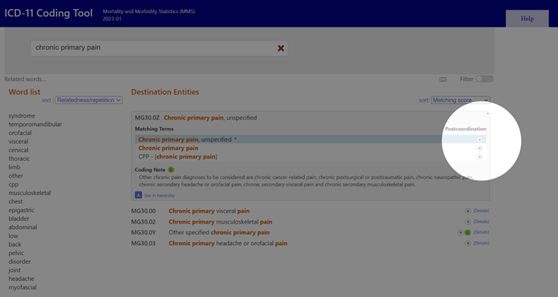
From here, you will be presented with the complete library of the ICD-11. Navigating the left panel, which includes information on the subtypes of CPP, and selecting the appropriate option will display the postcoordination information for that diagnosis. Here, you can then choose codes by clicking on the appropriate options. You can see from the image below that individual options are coded. For example, chronic widespread pain for which psychosocial factors are present, alongside moderate pain, distress and pain-related interference of an intermittent nature would be coded as:
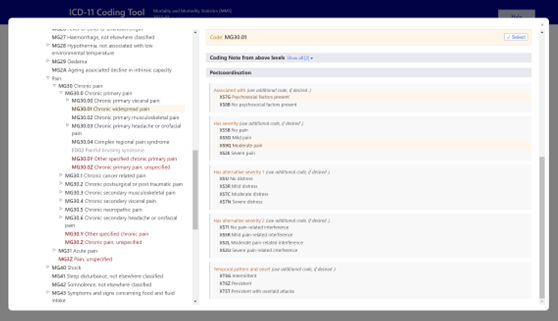
This process can be repeated for all manner of conditions within the database. Other options of diagnosis, for example complex regional pain syndrome, will include additional coding options relating to the laterality and the anatomical location of the symptoms. Additional ICD-11 tutorials and instructional materials, provided by the WHO, cover topics such as "An introduction to ICD-11", using the ICD-11 coding tool and gaining access to the ICD-11 coding list, and death certification, and can be found here.
Treatment approaches for chronic primary pain
Treating chronic pain can be difficult, not just for patients but also for clinicians. Unfortunately, there is no "gold standard", however, there are a few things you should consider when thinking about managing chronic pain. Utilising a holistic approach within a biopsychosocial framework that can be accessed not only in the primary care setting, but also in secondary and tertiary care, which provides strong emphasis on the delivery of multidisciplinary evidence-based practice, is suitable. To achieve this, a range of interventions can be considered:
Pharmacotherapy
The World Health Organisation provides information relating to the pharmacological management of chronic primary pain[7]. You can explore their recommendations here.
Physical activity and exercise
As far as evidence goes, promoting physical activity is something that can help a patient's pain in the long term. Patients and clinicians should seek to develop progressive and sustained levels of physical activity as part of an individualised multimodal pain treatment plan. The physical activity components of treatments for chronic pain should focus on not only the biomedical aspects, but also the psychological and social benefits of exercise whilst addressing barriers to long-term adherence. Ensuring effective behaviour change throughout the processes of treatment, via engagement of support networks, utilisation of social networks may facilitate adherence. Exercise programmes should aim to improve mental health, physical fitness and everyday quality of life[8]. For more information, visit the On The Move Campaign.
Psychological strategies
Cognitive behavioural therapies (CBT) or acceptance and commitment therapies (ACT) may improve quality of life for people with chronic primary pain. There is limited evidence of some benefit for relaxation, mindfulness, psychotherapies and hypnosis for the management of chronic primary pain. It may be suitable to consider these approaches, however, ensuring CBT or ACT interventions are delivered by healthcare professionals with appropriate training is key[7]. It may also be useful to assess the significance of providing additional interventions to address behaviour change and educational strategies promoting disease knowledge, self-management and more broad aspects of health literacy, such as health-related communication (see EFIC Plain Talking Campaign).
Understanding your condition
Education should be part of good clinical practice, and increasing an individual's understanding of their condition is important to promote self-management approaches. For this to happen, effective communication through considering health literacy-sensitive approaches needs to be adopted.
References
- [1]Nicholas M, Vlaeyen JW, Rief W, Barke A, Aziz Q, Benoliel R, Cohen M, Evers S, Giamberardino MA, Goebel A, Korwisi B. The IASP classification of chronic pain for ICD-11: chronic primary pain. Pain. 2019 Jan 1;160(1):28-37.
- [2]Butler S, Landmark T, Glette M, Borchgrevink P, Woodhouse A. Chronic widespread pain-the need for a standard definition. Pain. 2016 Mar 1;157(3):541-3.
- [3]International Association for the Study of Pain. Classification of chronic pain. 2nd edition (revised). www.iasp-pain.org/files/Content/ContentFolders/Publications2/ClassificationofChronicPain/Part_II-A.pdf
- [4]Treede RD, Rief W, Barke A, Aziz Q, Bennett MI, Benoliel R, Cohen M, Evers S, Finnerup NB, First MB, Giamberardino MA. Chronic pain as a symptom or a disease: the IASP Classification of Chronic Pain for the International Classification of Diseases (ICD-11). Pain. 2019 Jan 1;160(1):19-27.
- [5]Nicholas M, Vlaeyen JWS, Rief W, Barke A, Aziz Q, Benoliel R, Cohen M, Evers S, Giamberardino MA, Goebel A, Korwisi B, Perrot S, Svensson P, Wang SJ, Treede RD; The IASP Taskforce for the Classification of Chronic Pain. The IASP classification of chronic pain for ICD-11: chronic primary pain. Pain. 2019 Jan;160(1):28-37. DOI: 10.1097/j.pain.0000000000001390
- [6]Zinboonyahgoon N, Luansritisakul C, Eiamtanasate S, Duangburong S, Sanansilp V, Korwisi B, Barke A, Rief W, Treede RD. Comparing the ICD-11 chronic pain classification with ICD-10: how can the new coding system make chronic pain visible? A study in a tertiary care pain clinic setting. Pain. 2021 Jul 1;162(7):1995-2001.
- [7]NICE guideline NG193: chronic pain (primary and secondary) in over 16s
- [8]IASP fact sheet: physical activity for pain prevention
EFIC webinar on chronic primary pain
Watch this recording from a webinar on 28 April 2023, where we aimed to give an overview of the definition and new classification under ICD-11, as well as more information on the assessment and management of chronic primary pain.